Find the Missing Corner of a Rectangle
Free printable missing vertex worksheets: three corners of a rectangle given as coordinate pairs in four quadrants, find the fourth, with an answer key.
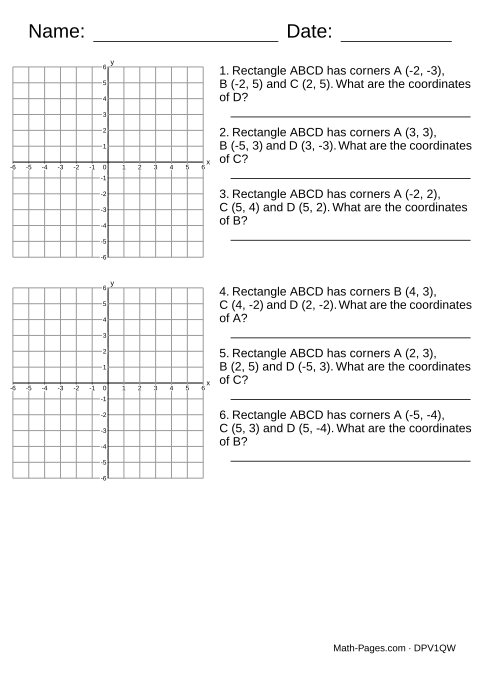
Each question names a rectangle, ABCD, and gives three of its corners as coordinate pairs. The student finds the fourth. The missing corner changes from question to question, so sometimes it is D and sometimes A, B or C, and the three that are given are always listed in alphabetical order.
Every side of the rectangle runs along a gridline, so two corners side by side share a coordinate. That gives the shortcut: the missing corner takes the first coordinate that appears only once among the three, and the second coordinate that appears only once. A student who has not seen that yet can plot the three corners on the blank grid printed beside every three questions and complete the rectangle.
The grids run from -6 to 6, and at least one rectangle beside each grid crosses an axis, so some corners have negative coordinates. No corner lies on an axis. The grid can be switched to the first quadrant, 0 to 10, in the settings.
What this worksheet covers
- Find the missing corner of a rectangle from the coordinates of the other three
- Use shared coordinates to tell which corners of a rectangle are side by side
- Work with corners in all four quadrants, including negative coordinates
Common Core standards
- 6.G.A.3 Draw polygons in the coordinate plane from the coordinates of their vertices, and use coordinates to find the length of a side joining points that share a coordinate.
- 6.NS.C.8 Solve problems on the coordinate plane, using coordinates and absolute value to find the distance between points that share a coordinate.
Frequently asked questions
How do you find the missing corner of a rectangle?
Each side runs along a gridline, so corners next to each other share a coordinate, and the missing corner shares one coordinate with each of its two neighbours. Among the three given corners, the first coordinate that appears only once and the second coordinate that appears only once make the answer. For A (2, 3), B (2, 7) and C (6, 7), the first coordinates are 2, 2 and 6 and the second are 3, 7 and 7, so D is at (6, 3).
Why is the grid blank?
The corners are in the question, not on the grid, so the sheet practises reading coordinates rather than reading a picture. The grid is there for working: a student can plot the three corners, draw the sides along the gridlines and read off the fourth corner. Three rectangles share each grid, so it helps to plot one at a time or use a different mark for each.
What changes when the rectangle crosses an axis?
The method is the same, but the signs need care. For A (-3, 4), B (5, 4) and C (5, -2), the first coordinates are -3, 5 and 5 and the second are 4, 4 and -2, so D is at (-3, -2). A common slip is to drop a minus sign, so a quick check is that D lines up with A on one gridline and with C on another.
Why is it always a rectangle, and never a square?
A rectangle with sides along gridlines has exactly one place for its fourth corner, found from the coordinates alone. A parallelogram has three possible fourth corners unless the order of its corners is given, and a slanted rectangle's corners rarely land where gridlines cross. The rectangles here are never squares, so no one has to stop and decide whether a square counts.