Volume of Cones
Free printable volume of cones worksheets: one third of 3.14 × r² × h, from a labelled radius or diameter and height. Exact decimal answers, with a key.
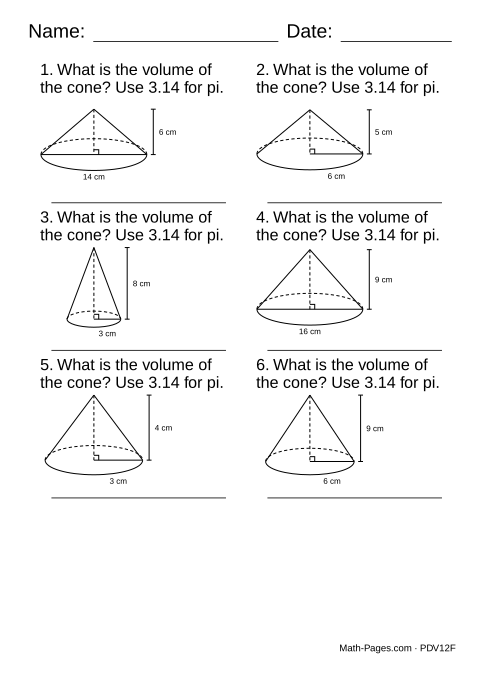
Each problem draws a cone, point up, with its height shown as a dashed line from the point straight down to the centre of the base, and its radius or diameter labelled across the base. The student finds the volume, using 3.14 for pi.
A cone holds one third as much as a cylinder with the same base and height, so its volume is one third of 3.14 × r² × h. A cone with a radius of 3 cm and a height of 4 cm is one third of 3.14 × 9 × 4 = 113.04, which is 37.68 cm³. When a problem gives the diameter, halve it first.
On these sheets the radius or the height is always a multiple of 3, so the third comes out exactly and every answer has at most two decimal places. Radii and heights are whole centimetres from 2 to 10, and the largest can be set to 5 or 12 in the settings.
What this worksheet covers
- Find the volume of a cone from its radius or diameter and its height
- Use the fact that a cone holds one third of a cylinder with the same base and height
Common Core standards
- 8.G.C.9 Know the formulas for the volumes of cones, cylinders, and spheres and use them to solve problems.
Frequently asked questions
How do you find the volume of a cone?
Work out the volume of the cylinder with the same base and height, then divide by 3: V = ⅓πr²h. For a radius of 3 cm and a height of 4 cm, the cylinder is 3.14 × 9 × 4 = 113.04 cm³, so the cone is 113.04 ÷ 3 = 37.68 cm³.
Why is a cone one third of a cylinder?
Fill a cone with water or sand and pour it into a cylinder with the same base and the same height, and it takes exactly three cones to fill it. Proving that it is exactly a third takes more geometry than eighth grade has, so classes usually show it by pouring.
Is the height the slanted side?
No. The height runs straight down from the point to the centre of the base, which is why it is drawn as a dashed line inside the cone. The slanted side is longer: a cone with a radius of 3 cm and a height of 4 cm has a slanted side of 5 cm, by the Pythagorean theorem. These sheets always label the height.
Is there a quicker way to do the arithmetic?
Divide by 3 first, where it goes exactly. A cone with a radius of 4 cm and a height of 6 cm is 3.14 × 16 × 6 ÷ 3, and dividing the 6 by 3 first leaves 3.14 × 16 × 2 = 3.14 × 32 = 100.48 cm³. On these sheets the radius or the height is always a multiple of 3, so one of them always divides.