Volume of Cylinders
Free printable volume of cylinders worksheets: find each cylinder's volume from its radius or diameter and its height, using 3.14 for pi. Answer key included.
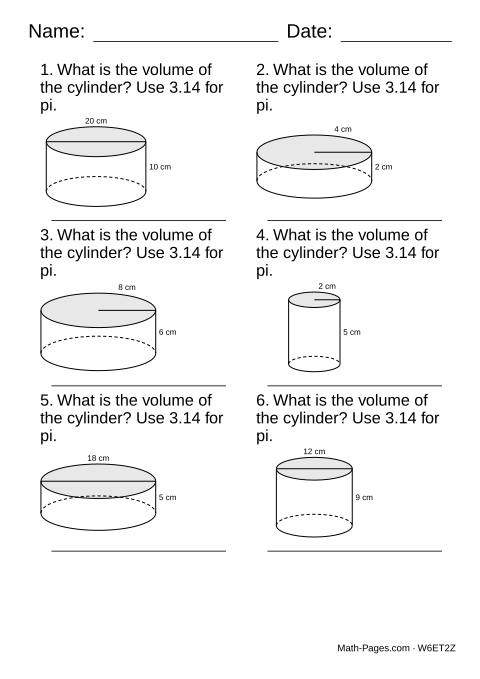
Each problem draws an upright cylinder with its height labelled, and either its radius or its diameter, and asks for the volume. Every prompt says to use 3.14 for pi, so a cylinder with a radius of 3 cm and a height of 5 cm has a volume of 3.14 × 3 × 3 × 5 = 141.3 cm³.
A cylinder is a stack of circles, the way a box is a stack of rectangles. The circle at the bottom has an area of 3.14 × r², and the height says how many layers of it there are, so the volume is the base area times the height. When a problem gives the diameter, halve it first: a diameter of 10 cm means a radius of 5 cm.
Radii and heights are whole centimetres from 2 to 10, and no cylinder is more than four times as wide as it is tall, or as tall as it is wide. With 3.14 for pi every answer is an exact decimal with at most two decimal places. The largest radius or height can be set to 5 or 12 in the settings.
What this worksheet covers
- Find the volume of a cylinder from its radius or diameter and its height
- Multiply the area of a circular base by the height
- Halve a diameter to find the radius
Common Core standards
- 8.G.C.9 Know the formulas for the volumes of cones, cylinders, and spheres and use them to solve problems.
Frequently asked questions
How do you find the volume of a cylinder?
Find the area of the circular base, then multiply by the height: V = πr²h. With 3.14 for pi, a cylinder with a radius of 3 cm has a base of 3.14 × 9 = 28.26 cm². If it is 5 cm tall, its volume is 28.26 × 5 = 141.3 cm³.
What if the diameter is given instead of the radius?
Halve it before using the formula. A cylinder with a diameter of 10 cm and a height of 4 cm has a radius of 5 cm, so its volume is 3.14 × 25 × 4 = 314 cm³. Using 10 as the radius gives 1,256 cm³, four times too much, because the radius is multiplied by itself.
Why is the answer an exact decimal if pi never ends?
Because the question says to use 3.14. Pi itself is 3.14159… and never ends, so the true volume of a cylinder with a whole-number radius is never a finite decimal. With 3.14 in its place, the answer is the radius squared, times the height, times 3.14, and that has at most two decimal places, which a key can check digit for digit.
What grade learns the volume of a cylinder?
Eighth grade. It joins two earlier ideas: fifth grade's volume of a box as the area of one layer times the number of layers, and seventh grade's area of a circle. A cylinder's volume is the second used in the first.