Systems of Equations
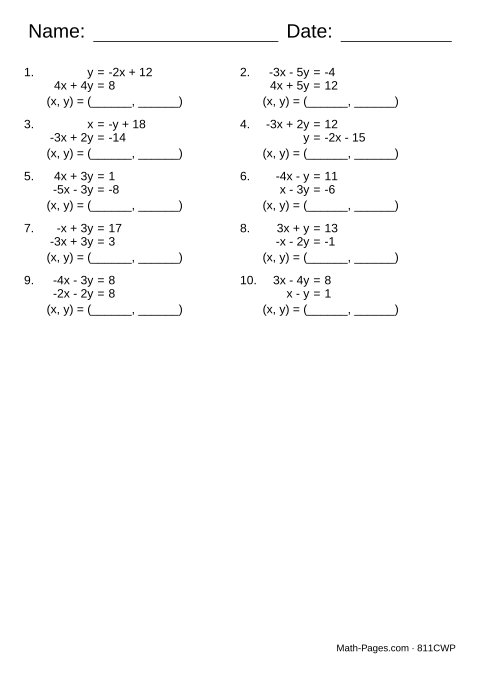
Free printable systems of equations worksheets: pairs of equations in x and y to solve by substitution or elimination, with negatives. Answer key included.
Each problem is a pair of equations in x and y, like 2x + 3y = 18 and 2x + y = 10. The solution is the one pair of numbers that makes both equations true, written as an ordered pair: here (3, 4). Check it in both: 2 × 3 + 3 × 4 = 18 and 2 × 3 + 4 = 10.
Every sheet mixes three kinds of system. In some, one equation is already solved for a variable, like y = 2x + 1, ready to substitute into the other. In some, one variable has the same or opposite coefficients in both equations, so adding or subtracting them removes it. In the rest, one equation has to be multiplied first. The sheet uses negative numbers, so a solution can fall in any quadrant. Every system has exactly one solution, and the answer key gives it as an ordered pair. Turn off Negative Numbers under Advanced options for a sheet where every number printed is positive.
What this worksheet covers
- Solve systems of two linear equations by substitution
- Solve systems of two linear equations by elimination
- Check that an ordered pair satisfies both equations
Common Core standards
- 8.EE.C.8 Analyze and solve pairs of simultaneous linear equations.
Frequently asked questions
How do you solve a system by substitution?
Start from the equation that is already solved for a variable. In y = 2x + 1 and 3x + y = 16, replace y in the second equation with 2x + 1: 3x + 2x + 1 = 16, so 5x = 15 and x = 3. Then y = 2 × 3 + 1 = 7, and the solution is (3, 7).
How do you solve a system by elimination?
Add or subtract the equations so that one variable drops out. In 3x + 2y = 5 and 5x - 2y = 19, the y terms are opposites, so adding the equations gives 8x = 24, and x = 3. Put 3 back into the first equation: 9 + 2y = 5, so 2y = -4 and y = -2. The solution is (3, -2).
What if no coefficients match?
Multiply one equation so that they do. In 2x + 3y = 12 and 4x + y = 14, multiplying the first equation by 2 gives 4x + 6y = 24. Subtracting the second equation leaves 5y = 10, so y = 2, and then 2x + 6 = 12 gives x = 3. The solution is (3, 2).
What does the solution mean on a graph?
Each equation is a straight line, and the solution is the point where the two lines cross. The point (3, 4) is on both 2x + 3y = 18 and 2x + y = 10, so those lines cross there. Two different lines with the same slope never cross, like x + y = 5 and x + y = 7, so that system has no solution. If both equations describe the same line, every point on it is a solution. On these sheets the two lines always cross at exactly one point.
What grade is this?
Eighth grade. It comes after equations with the variable on both sides: substitution and elimination both turn a system into a single equation in one variable, and the rest is solving it and putting the value back.