Three-Digit Addition and Subtraction
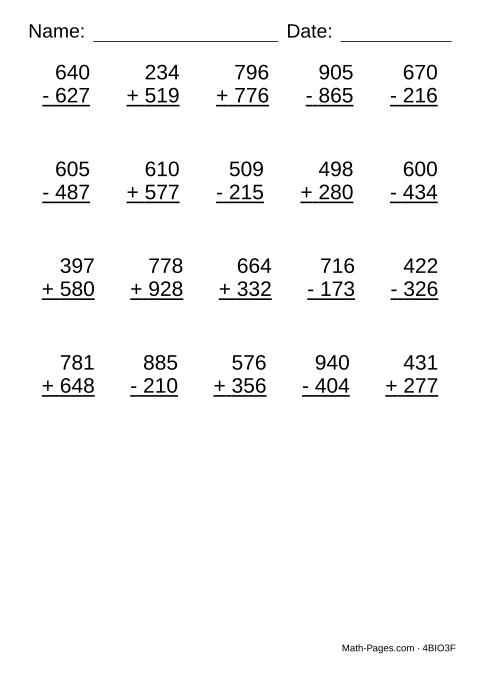
Free printable three-digit addition and subtraction worksheets for 3rd grade. Column problems with and without regrouping, with an answer key.
Third grade extends the column methods to three digits, where a problem can carry twice or borrow across a zero. Both numbers here run from 100 to 999, set out vertically with the ones, tens and hundreds lined up.
Mixed regrouping is the default, so some problems carry and some do not and each one has to be looked at. More than half of the additions run past 1,000 into a fourth digit; the FAQ below shows how to keep every sum under it. Borrowing across a zero is the step that most often goes wrong, and it comes up on about one page in three.
What this worksheet covers
- Add and subtract three-digit numbers, including sums that pass 1,000
- Carry or borrow across more than one column, including across a zero
Common Core standards
- 2.NBT.B.7 Add and subtract within 1,000 using place-value strategies.
- 3.NBT.A.2 Fluently add and subtract within 1,000.
Frequently asked questions
Can I get only problems with regrouping?
Yes. Set Regrouping to Regrouping Only in the advanced options and every problem will carry or borrow at least once.
Do the answers stay under 1,000?
The subtraction answers always do. About six additions in ten pass 1,000, such as 572 + 940 = 1,512. To keep every sum below it, untick 500 to 900 in both ranges so that neither number is above 499.
How do you borrow across a zero?
Go one more column to the left. In 403 - 158 there are no tens to borrow, so take one hundred, leaving 3 hundreds, and turn it into 10 tens. Then take one of those tens for the ones column, leaving 9 tens. The top number is now 3 hundreds, 9 tens and 13 ones, and the answer is 245.
What grade is three-digit addition and subtraction?
Third grade, where adding and subtracting within 1,000 is expected to be fluent. Fourth grade carries the same method on to larger numbers.