Even and Odd Numbers Worksheets
Free printable even and odd numbers worksheets. Decide whether a number is even or odd, with an answer key. Two and three digit numbers.
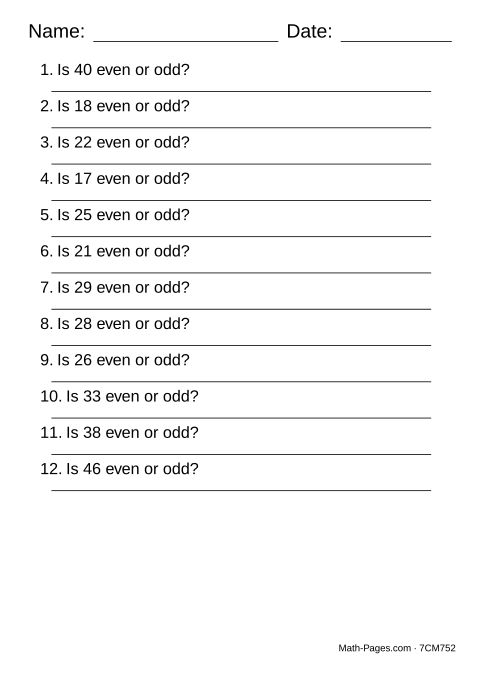
Each question names a number and asks whether it is even or odd. The numbers are always at least two digits, because the skill is reading the last digit rather than counting - a student who has to count to decide about 7 has not met the rule yet.
Even and odd is the first divisibility rule anyone learns: a number is even exactly when it divides by 2. That is why it sits on the same generator as factors, and why the two often appear in the same unit.
What this worksheet covers
- Decide whether a number is even or odd
- Use the ones digit to tell even from odd
Common Core standards
- 2.OA.C.3 Determine whether a number is odd or even.
Frequently asked questions
How do you tell if a number is even or odd?
Look at the last digit only. If it ends in 0, 2, 4, 6 or 8 the number is even; if it ends in 1, 3, 5, 7 or 9 it is odd. The other digits never matter, however many there are.
Why do the numbers have two digits?
Because a one-digit question can be answered by counting, and this is meant to practise the last-digit rule. 138 and 7 are the same question only if you know the rule.
Is zero even or odd?
Even - it divides by 2 with nothing left over. It does not appear on these sheets, though, since the numbers start at ten.
What grade is this?
Second grade, and it comes back in fourth and fifth as the first of the divisibility rules.