Exponents Worksheets
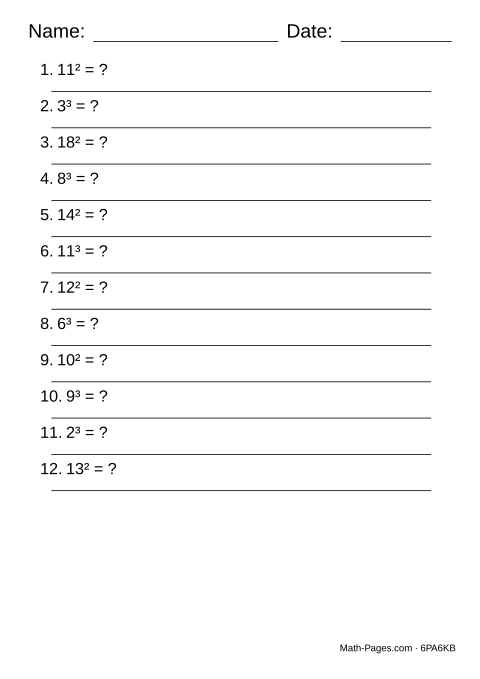
Free printable exponents worksheets. Evaluate squares and cubes - 7², 4³ - with a full answer key. Squares to 20 and cubes to 12.
Each question is a number raised to a power: 7² = ?, 4³ = ?. Squares go up to 20 and cubes to 12, which is as far as the arithmetic is worth doing by hand - 20³ is 8,000, and writing that out teaches multiplication rather than exponents.
These sheets stay at squares and cubes. That is what sixth to eighth grade uses, and a fourth power is a calculator exercise rather than something to practise. Our order of operations worksheets put squares and cubes inside longer expressions once evaluating them on their own is automatic.
What this worksheet covers
- Evaluate squares and cubes of whole numbers
- Read an exponent as repeated multiplication
Common Core standards
- 6.EE.A.1 Write and evaluate numerical expressions with whole-number exponents.
Frequently asked questions
What does an exponent mean?
How many times to multiply a number by itself. 4³ is 4 × 4 × 4, which is 64. The small raised number is the count, not something to multiply by.
What is the difference between 4³ and 4 × 3?
4 × 3 is 12; 4³ is 64. It is the most common mistake with exponents, and it is why these sheets ask for the value rather than for the expanded form.
Why only squares and cubes?
Because those are the powers that come up in real work - area is a square, volume is a cube - and because anything higher is a calculator exercise. They are also the two that print properly on a worksheet.
What grade are exponents?
Sixth grade introduces them, and they are used from then on in order of operations, area and volume, and eventually in scientific notation.