Prime and Composite Numbers
Free printable prime and composite numbers worksheets. Decide whether a number is prime or composite, with an answer key. Two and three digit numbers.
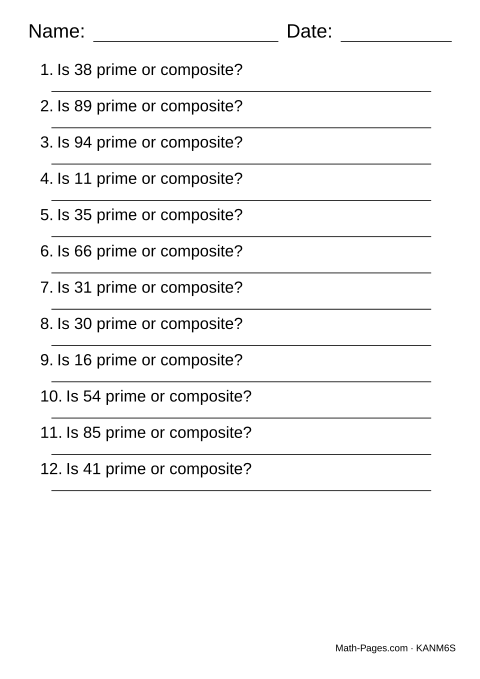
Each question names a number and asks whether it is prime or composite. A number is prime when it has exactly two factors - one and itself - and composite when it has more. Deciding means looking for a factor, not recalling a list.
The numbers are always at least two digits. Below ten the answer is memorised rather than worked out, and the skill here is knowing what to divide by: check 2, 3, 5, 7 and stop once the divisor squared passes the number.
What this worksheet covers
- Decide whether a number up to 100 is prime or composite
- Look for a factor other than 1 and the number itself
Common Core standards
- 4.OA.B.4 Find factor pairs and multiples of whole numbers to 100, and tell prime from composite.
Frequently asked questions
What is a prime number?
A whole number with exactly two factors: one and itself. 29 is prime because nothing between 2 and 28 divides it. 51 is not, because 3 × 17 is 51.
Is 1 prime or composite?
Neither. It has only one factor, so it fails the definition of prime, and it has no others, so it is not composite. It does not appear on these sheets.
How do I check a number quickly?
Try 2, 3, 5, 7, 11 and so on, and stop when the divisor multiplied by itself passes the number. For 91 you only need to reach 7 - and 7 × 13 is 91, so it is composite.
What grade is this?
Fourth and fifth grade, taught alongside factors - which is exactly what a primality check is, so both are on the same generator here.