Factors Worksheets
Free printable factors worksheets. List all the factors of a number, with a full answer key. Numbers up to 144, chosen so the lists stay short.
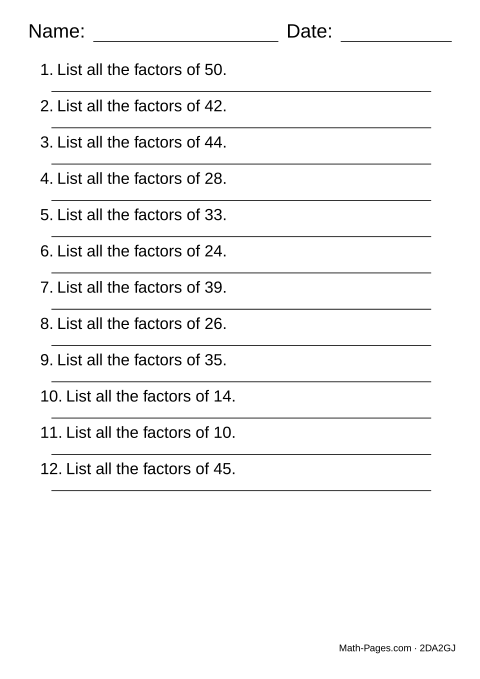
Each question names a number and asks for all of its factors: the factors of 63 are 1, 3, 7, 9, 21 and 63. There is a ruled line under every question, because a factor list needs more room than the question that asks for it.
The numbers are chosen so no answer runs past eight factors. That is not a shortcut - it is what keeps the answer key readable, and it means a student is never asked to find the twelve factors of 96 in the same space as the two of 67. Largest number sets how big the numbers get; 144 is the top of the times tables and a sensible ceiling.
What this worksheet covers
- List every factor of a number
- Find factors in pairs so none is missed
Common Core standards
- 4.OA.B.4 Find factor pairs and multiples of whole numbers to 100, and tell prime from composite.
Frequently asked questions
What is a factor?
A whole number that divides into another with nothing left over. 7 is a factor of 63 because 63 ÷ 7 is exactly 9. Every number has 1 and itself as factors.
How do you find all the factors of a number?
Work up from 1 in pairs: 1 × 63, 3 × 21, 7 × 9. Each pair gives two factors, and you can stop when the pair meets in the middle. Listing them in order makes it obvious when one has been missed.
What grade is this?
Fourth grade introduces factors, and they matter most in fifth and sixth when simplifying fractions and finding common denominators.
Why are some numbers never asked about?
Numbers with more than eight factors are left out. 96 has twelve, and an answer key that prints twelve numbers on one line stops being a key you can scan.