Greatest Common Factor Worksheets
Free printable GCF worksheets. Find the greatest common factor of two numbers, with an answer key. Every pair has a common factor worth finding.
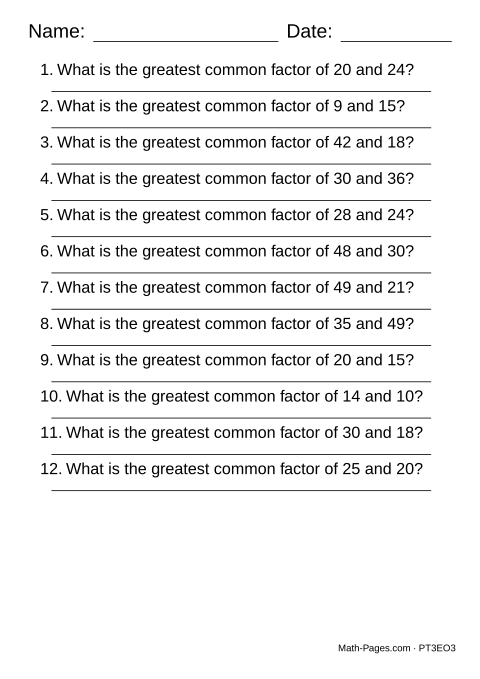
Each question gives two numbers and asks for the largest factor they share: the greatest common factor of 96 and 84 is 12. Every pair on the sheet has a genuine common factor - the answer is never 1.
That is a deliberate choice. Two numbers picked at random usually share nothing but 1, and a page of questions answered "1" teaches a student to guess rather than to look. These pairs are built around a shared factor, so the work of finding it is always work worth doing.
What this worksheet covers
- Find the greatest common factor of two numbers
- Compare factor lists to find the largest shared factor
Common Core standards
- 6.NS.B.4 Find the greatest common factor and least common multiple of two whole numbers.
Frequently asked questions
What is the greatest common factor?
The largest number that divides into both. For 24 and 42, the common factors are 1, 2, 3 and 6, so the GCF is 6.
How do you find it?
List the factors of each number and look for the largest that appears in both. With larger numbers it is quicker to break each into its prime factors and multiply the ones they share.
Why is the answer never 1?
Because every pair here is built from a shared factor on purpose. Coprime pairs are a real case, but a sheet of them is a sheet about noticing there is nothing to find.
What is GCF used for?
Simplifying fractions, mostly. Reducing 18/24 to 3/4 means dividing both by their GCF of 6, which is why this shows up right before fraction work in fifth and sixth grade.