Mean, Median, Mode and Range Worksheets
Free printable mean, median, mode and range worksheets. Each problem states a list of numbers and asks for one statistic, with an answer key.
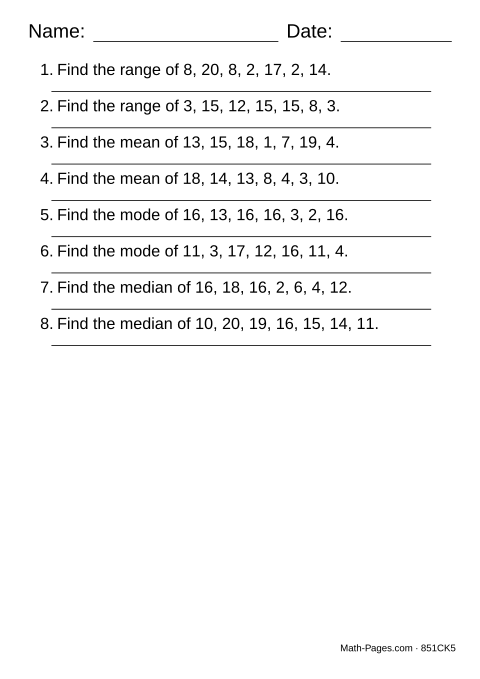
Each problem states a list of whole numbers and asks for one thing about it: the mean, the median, the mode, or the range. The four rotate through the sheet, so a student has to notice which is being asked before reaching for the right method - the actual skill, once each calculation is familiar on its own.
Every list is built so the question has one clean answer. A mean always comes out to a whole number rather than a decimal remainder; a list always has exactly one mode, never a tie and never none; and with an odd-length list, the median is always one of the stated values rather than an average of the middle two.
What this worksheet covers
- Find the mean, median, mode or range of a data set
- Choose the right method for the measure being asked for
Common Core standards
- 6.SP.B.5c Summarize a data set with measures of center, such as the mean and median.
Frequently asked questions
What is the difference between mean, median, mode and range?
The mean is the total shared out evenly - add the list and divide by how many numbers there are. The median is the middle value once the list is sorted. The mode is whichever value shows up most. The range is the highest value minus the lowest.
How do you find the mean of a list of numbers?
Add every number in the list, then divide by how many numbers there are. For 4, 9, 6, 7, 4 that is 30 divided by 5, which is 6.
Why is the mean always a whole number on this worksheet?
The list is built from the mean rather than checked afterwards, so it always divides evenly. A mean of 6.4 is a decimals problem wearing a statistics question, and our decimals worksheets are the place for that.
What grade level is mean, median, mode and range?
Sixth grade is where all four are typically taught together (6.SP.A), building on the averaging and sorting skills fourth and fifth grade introduce separately.