Multiplying and Dividing in Scientific Notation
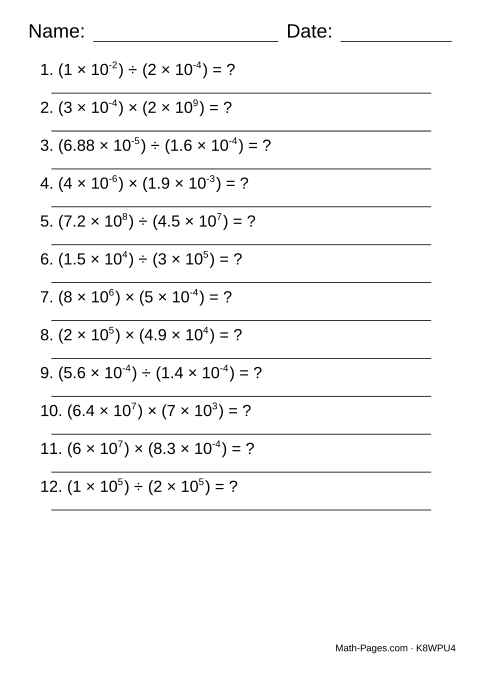
Free printable worksheets for multiplying and dividing numbers in scientific notation, with positive and negative exponents. Answer key included.
To multiply, multiply the numbers in front and add the exponents: (3 × 10⁴) × (2 × 10⁵) = 6 × 10⁹. To divide, divide the numbers and subtract the exponents: (8 × 10⁹) ÷ (2 × 10³) = 4 × 10⁶.
Half the answers need one more step. (5 × 10³) × (4 × 10⁵) gives 20 × 10⁸, and 20 is too big to stand in front, so it becomes 2 × 10⁹. The answer key shows both steps, so you can see whether a mistake was in the arithmetic or in the rewriting. Half the questions are multiplication and half division, and the exponents run from -6 to 9.
What this worksheet covers
- Multiply and divide numbers in scientific notation
- Rewrite a result in scientific notation
Common Core standards
- 8.EE.A.4 Perform operations with numbers expressed in scientific notation.
Frequently asked questions
How do you multiply numbers in scientific notation?
Multiply the coefficients and add the exponents, then check that the coefficient is from 1 to under 10. (2.5 × 10³) × (3 × 10⁴) is 7.5 × 10⁷.
How do you divide numbers in scientific notation?
Divide the coefficients and subtract the exponents. (9 × 10⁸) ÷ (3 × 10⁻²) is 3 × 10¹⁰, because 8 - (-2) = 10.
What if the coefficient ends up less than 1?
Move the decimal point and change the exponent to match. (2 × 10⁷) ÷ (4 × 10³) gives 0.5 × 10⁴, which is the same as 5 × 10³: the coefficient got ten times bigger, so the exponent goes down by one.
What grade is multiplying scientific notation?
Eighth grade, as part of working with very large and very small numbers. It uses the rule for multiplying powers of ten, which is why it comes after writing numbers in scientific notation.