Comparing Fractions With Models
Free printable worksheets for comparing fractions with pictures. Two shaded bars, same width - write <, > or = by looking, not calculating.
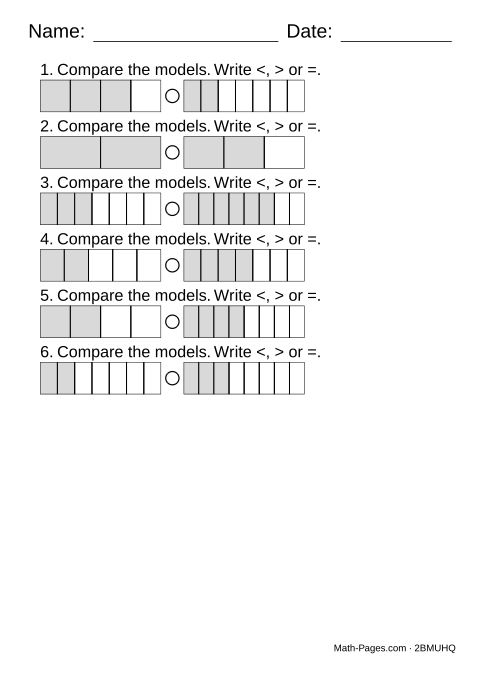
Each problem shows two bars of the same width, divided into their own number of equal parts and shaded, and the student writes <, > or = between them. Because both bars are the same width, the one shaded further along is the larger fraction - no common denominator or cross-multiplying required.
The two bars usually have different numbers of parts on purpose: two bars split the same way is just counting, not comparing. About one problem in ten is a genuine equality - two bars with different numbers of parts shaded exactly as far, like 2/4 next to 1/2 - which is the case that makes the visual method worth trusting: it agrees with the arithmetic every time.
What this worksheet covers
- Compare two fractions using same-sized fraction bars
- Write <, > or = to record the comparison
Common Core standards
- 4.NF.A.2 Compare two fractions with different numerators and different denominators, including with a visual model.
Try it with fraction bars
Split bars into halves, thirds, all the way to twelfths, and shade some of the pieces. Line the bars up under the whole to see which fractions are equal and which is larger.
Frequently asked questions
How do you compare fractions from a picture like this?
Since both bars are the same total width, compare how far the shading reaches. The bar shaded further along represents the larger fraction - the number of parts each bar is cut into does not matter for comparing, only the total length shaded.
Can two bars with a different number of parts be equal?
Yes, and it happens on purpose about one time in ten - a bar cut into quarters with two shaded reaches exactly as far as a bar cut in half with one shaded, because 2/4 and 1/2 are the same value.
Do the two bars ever have the same number of parts?
Sometimes, but not most of the time on purpose - two bars split into the same number of parts turns the question into simple counting rather than a real comparison.
How is this different from the Comparing Fractions page?
That page writes both fractions as numbers and expects a common-denominator or cross-multiplication method. This page answers by looking at two pictures instead - the visual method most curricula teach before the numeric one.