Adding Fractions With Unlike Denominators
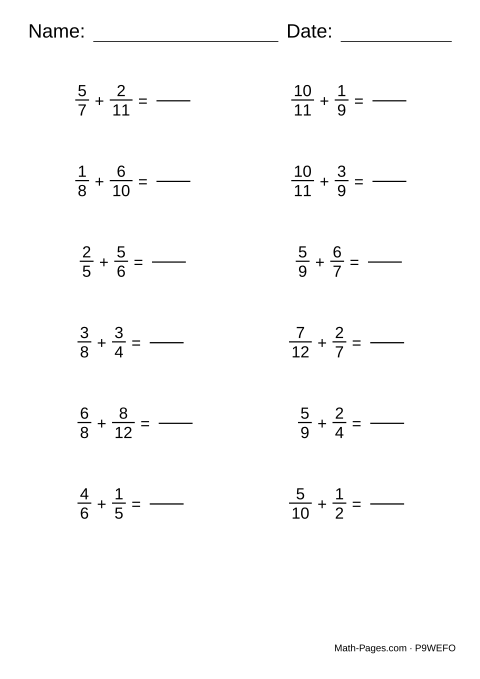
Free printable worksheets for adding fractions with unlike denominators. Every problem needs a common denominator, with answers in lowest terms.
Every problem on this sheet has two different denominators, so none of them can be added straight across - a common denominator has to be found first, every time. That is the point of drilling it this way: the procedure gets repeated until it is automatic.
It is also the limitation. A page where every problem needs a common denominator does not ask the student to notice when one is needed. Once the mechanic is reliable, move to the Adding Fractions page, which mixes both kinds and puts that decision back.
What this worksheet covers
- Find a common denominator for two fractions
- Rewrite both fractions as equivalents before adding
- Simplify the answer to lowest terms
Common Core standards
- 5.NF.A.1 Add and subtract fractions with unlike denominators by finding equivalent fractions.
Frequently asked questions
What is the easiest way to find a common denominator?
Multiplying the two denominators together always gives one, and the answer reduces at the end anyway. The least common multiple gives smaller numbers to work with if a student can find it.
What is the most common mistake when adding fractions?
Adding the tops and the bottoms separately, so 1/2 + 1/3 becomes 2/5. That is less than 1/2, which shows it cannot be right. The correct sum is 3/6 + 2/6, which is 5/6.
What grade is this?
Fifth grade in most curricula - adding and subtracting fractions with unlike denominators is one of that year's core fraction standards.
Can I make the numbers easier?
Set Largest Denominator to 6. Smaller denominators mean smaller common denominators and less reducing at the end.
Can the answer key show how to get the common denominator?
Yes. Tick Answer key, then Show the working, and the key rewrites each pair over the common denominator, adds them, and reduces - the three steps written out for every problem.