Dividing Fractions
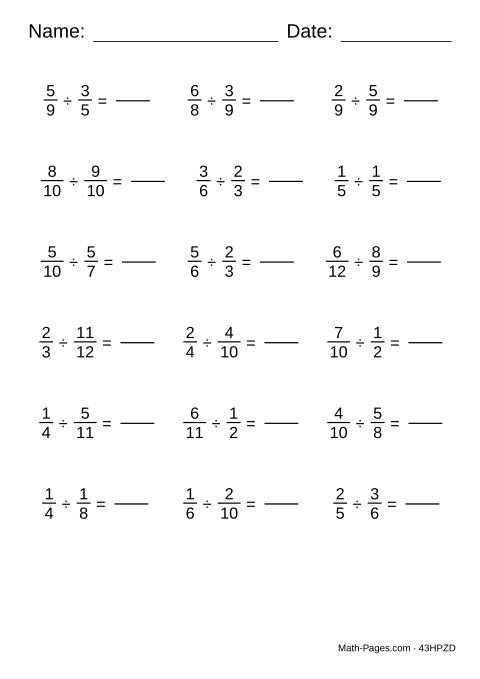
Free printable dividing fractions worksheets. Divide proper fractions by flipping the second and multiplying, with answers in lowest terms.
Eighteen problems to a sheet, the same count as the multiplying page, because dividing fractions is multiplying with one extra step: flip the second fraction over and multiply straight across. No common denominator is needed, so the Denominators setting does not appear here either.
The flip is the whole idea, and it is worth being able to say why it works: dividing by 2/3 is the same as multiplying by 3/2, because a third of something goes into it three times per whole. A student who divides 1/2 by 3/4 and writes 4/6 has done the arithmetic and left the answer unreduced - which the key will show as 2/3.
What this worksheet covers
- Divide by a fraction by multiplying by its reciprocal
- Simplify the quotient and write it as a mixed number where needed
Common Core standards
- 6.NS.A.1 Interpret and compute quotients of fractions.
Frequently asked questions
How do you divide fractions?
Keep the first fraction, flip the second one so its numerator and denominator swap, and multiply the two straight across. Then reduce the result.
Why do you flip the second fraction?
Because dividing by a number is the same as multiplying by its reciprocal. Dividing by 3/4 asks how many three-quarters fit in something, and that is what multiplying by 4/3 counts.
Why can the answer be bigger than the fractions I started with?
Because dividing by a fraction less than one asks how many of those pieces fit. 3/4 ÷ 1/8 is 6, since six eighths make three quarters.
Why is there no denominator setting on this page?
Dividing never needs a common denominator, so the like/unlike choice would make no difference. It appears on the adding and subtracting pages instead.