Comparing Fractions Worksheets
Free printable comparing fractions worksheets. Write the correct symbol between two fractions, with an answer key. Values are close enough to need a method.
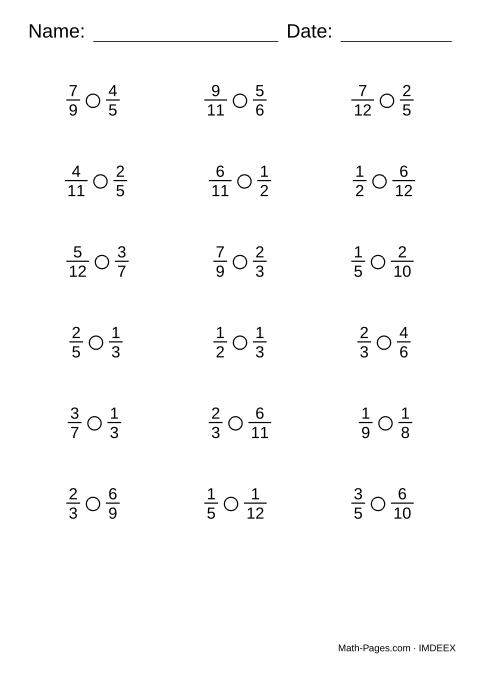
Each problem is two fractions with unlike denominators, and the student writes the correct symbol - less than, greater than or equal - between them. The two values are close, so eyeballing does not work: you have to rewrite them over a common denominator or cross-multiply.
About one problem in ten is an equality, and it is the interesting one - 2/4 and 1/2, or 3/6 and 1/2 - because it looks like the fractions are different until you check.
What this worksheet covers
- Compare two fractions with different denominators
- Rewrite fractions over a common denominator to decide which is larger
- Write <, > or = between them
Common Core standards
- 4.NF.A.2 Compare two fractions with different numerators and different denominators, including with a visual model.
Frequently asked questions
How do you compare two fractions?
Rewrite both over a common denominator and compare the numerators, or cross-multiply: for a/b and c/d, compare a x d with c x b.
Why are the fractions so close in value?
So a method is needed. 1/8 next to 7/8 tells you nothing about whether a student can compare fractions - 3/5 next to 5/8 does.
Are there any equal pairs?
Yes, roughly one in ten, and they are written to look unequal - like 3/4 and 6/8 - so the student has to actually check rather than assume.
What grade is comparing fractions?
Third and fourth grade. Fourth grade is where the fractions stop having the same denominator and a method becomes necessary.