Equivalent Fractions Worksheets
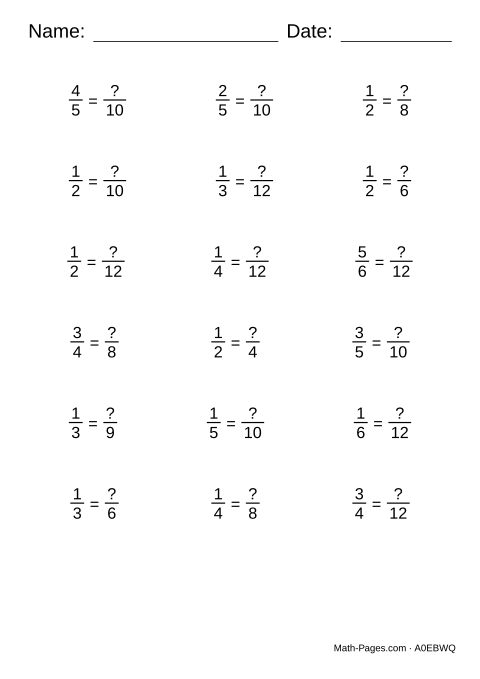
Free printable equivalent fractions worksheets. Fill in the missing numerator to make two fractions equal, with an answer key.
Each problem gives a fraction and a second fraction with the same value but a larger denominator and a blank numerator. The student works out what number the top must be. It is the step before adding fractions with unlike denominators, where finding a common denominator is exactly this.
Whatever you multiply the denominator by, you multiply the numerator by the same. 2/3 with a denominator of 12 means multiplying by 4, so the numerator is 8.
What this worksheet covers
- Find the missing numerator in an equivalent fraction
- Multiply the numerator and denominator by the same number
Common Core standards
- 3.NF.A.3b Recognize and generate simple equivalent fractions.
- 4.NF.A.1 Explain and generate equivalent fractions by multiplying or dividing the numerator and denominator.
Frequently asked questions
What are equivalent fractions?
Two fractions that represent the same amount, like 1/2 and 3/6. You get one from the other by multiplying or dividing the top and bottom by the same number.
How do you find the missing numerator?
See what the denominator was multiplied by, then multiply the numerator by the same number.
Why does this matter for adding fractions?
To add 1/3 and 1/4 you first rewrite both over 12 - which is finding equivalent fractions. This page practises that step on its own.
What grade is this?
Third and fourth grade, before adding and subtracting fractions with unlike denominators.