Identifying Fractions From a Model
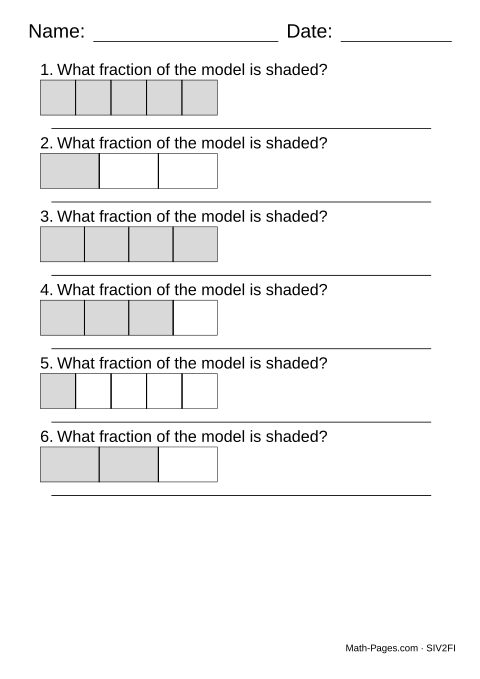
Free printable worksheets for identifying fractions from a picture. Each problem shows a bar split into equal parts, some shaded, and asks what fraction it is.
Each problem shows a rectangle divided into equal parts, some of them shaded grey, and the student writes what fraction of it is shaded. The denominator is how many parts the bar is cut into; the numerator is how many are shaded - both are counted straight off the picture, not measured.
Answers are not simplified. A bar cut into four parts with two shaded is written as 2/4, because that is what the picture shows - reducing it to 1/2 is a second, separate skill, and this site's Simplifying Fractions page is where that gets practised.
What this worksheet covers
- Name the fraction of a shape that is shaded
- Read the denominator as the number of equal parts and the numerator as the parts shaded
Common Core standards
- 3.NF.A.1 Understand a fraction as parts of a whole divided into equal parts.
Try it with fraction bars
Split bars into halves, thirds, all the way to twelfths, and shade some of the pieces. Line the bars up under the whole to see which fractions are equal and which is larger.
Frequently asked questions
How do you read a fraction from a model like this?
Count the total number of equal parts the shape is divided into - that is the denominator - then count how many of them are shaded, which is the numerator.
Is the answer ever simplified?
No. If four parts are shown and two are shaded, the answer is 2/4, matching the picture exactly. Simplifying it to 1/2 is a different question - see the Simplifying Fractions page for that.
Why are the bars, not circles or pies?
A bar's parts are easy to count at a glance because they are all the same width in a row. Denominators only go up to twelve, and lower by default, so no part is ever too thin to count.
What grade is this for?
Third grade, where fractions are introduced as equal parts of a whole - this is usually the first way a student meets a fraction at all, before any arithmetic with them.