Elapsed Time on a Number Line
Free printable elapsed-time-on-a-number-line worksheets. A start and an end time marked on a line - count on to find how much time passed - with an answer key.
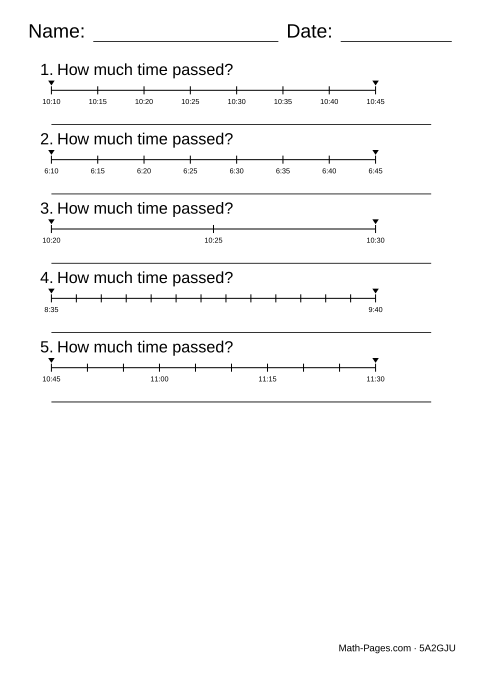
Each problem is a number line with two arrows on it - a start time and an end time - and the student counts the ticks between them to find how much time passed. This is how most classrooms actually teach elapsed time: counting on in jumps, rather than subtracting two clock readings, because that is the method that catches the mistakes borrowing across the hour makes.
Every tick on the line is one of the sheet's own intervals, so a five-minute sheet's line only ever has five-minute ticks and both arrows always land exactly on one. Longer spans are drawn with wider ticks and shorter ones with narrower - the line never shows more than sixteen ticks, which is what keeps every mark far enough apart to read without a ruler. On a fine interval that means a shorter question: a to-the-minute sheet asks about spans up to sixteen minutes here, not the hour-long spans the clock-face pages allow.
The answer key redraws the same line with both times marked, whichever one the worksheet left blank - never on the worksheet page itself, where marking it would print the answer.
What this worksheet covers
- Count the time between two points on a number line
- Use jumps of hours and minutes to find elapsed time
Common Core standards
- 3.MD.A.1 Tell time to the nearest minute and solve problems about time intervals in minutes.
Frequently asked questions
Why a number line instead of two clocks?
Counting on from a start time to an end time in jumps is how most curricula teach elapsed time, and a number line is what that counting looks like. Two clock faces show the same two times but nothing to count between them.
Why do the questions get shorter on the five-minute and minute settings?
The line never shows more than sixteen ticks, so a mark is never squeezed in between two ticks with no room to read it. At a coarse interval, like the hour, sixteen ticks is a sixteen-hour span; at the minute, it is sixteen minutes. The tick spacing always matches the sheet's interval - it is the length of the question that gives way, not the line.
Does the worksheet ever mark the time it is asking for?
No. "What time does it end" marks only the start; "What time started" marks only the end; "How much time passed" marks both, since neither one is the answer there. The answer key marks both, always.
Can I get the same question without a drawn line?
Yes - Elapsed Time Worksheets asks the same three question types with clock faces or digital times instead, and Elapsed Time Word Problems phrases them as short stories.