A.M. and P.M. Worksheets
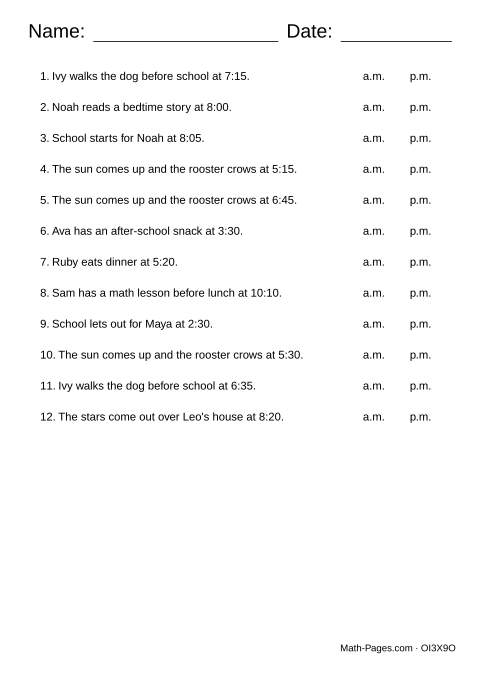
Free printable a.m. and p.m. worksheets. Each problem gives an everyday event and its time, and the child circles a.m. or p.m. Answer key included.
Each problem names something from an ordinary day and the time it happens, like "Ava eats breakfast at 7:30." The child circles a.m. or p.m. The answer key rings the right one.
The time is printed, not drawn on a clock face, so the only question is which half of the day it is. A child who is still learning to read the hands isn't marked wrong on a question about breakfast. Reading the clock has its own pages.
Every event happens clearly on one side of noon: waking up, the school bus, dinner, bedtime. No time falls in the 11 or 12 o'clock hours, where even adults hesitate. About half the answers are a.m. and half p.m., so circling the same one every time gets about half right.
What this worksheet covers
- Decide whether an everyday event happens a.m. or p.m.
- Know that a.m. is before noon and p.m. is after it
Common Core standards
- 2.MD.C.7 Tell and write time from analog and digital clocks to the nearest five minutes.
Frequently asked questions
What do a.m. and p.m. mean?
a.m. means before noon, from midnight until just before 12 noon. p.m. means after noon, from noon until just before midnight. The letters stand for the Latin ante meridiem and post meridiem: before midday and after midday.
What grade learns a.m. and p.m.?
Second grade, alongside telling time to five minutes. Working out elapsed time from an a.m. time to a p.m. time follows in third grade.
Is 12:00 noon a.m. or p.m.?
Noon is written 12:00 p.m. and midnight is 12:00 a.m. That trips people up, which is why no problem on this sheet uses the 12 o'clock hour. The skill here is telling morning from afternoon and evening.
Why isn't there a clock face?
So the sheet tests one thing. A child who misreads the hands would get an a.m. or p.m. question wrong for the wrong reason. If you want both skills, use a telling-time sheet first and this one after it.