Exponent Rules Worksheets
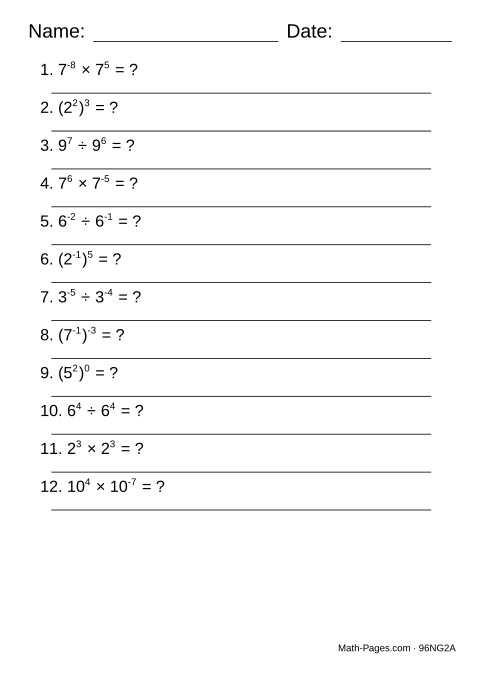
Free printable exponent rules worksheets: multiply and divide powers, raise a power to a power, and work with zero and negative exponents. Answer key included.
Each question uses one of three rules for powers of the same number. To multiply, add the exponents: 3² × 3⁻⁵ = 3⁻³. To divide, subtract them: 4⁵ ÷ 4⁷ = 4⁻². To raise a power to a power, multiply them: (2³)² = 2⁶. Then find the value: 2⁶ is 64.
A negative exponent means one over the power, so 3⁻³ is 1/3³, which is 1/27, and a zero exponent always gives 1. Of the twelve answers on a sheet, four to six have a negative exponent and two or three have a zero exponent. The answer key shows the single power before its value, so you can see whether a mistake was in the rule or in the arithmetic. No final power is bigger than a cube, apart from powers of 2 up to 2⁶ and 3⁴, so the arithmetic can be done by hand.
What this worksheet covers
- Multiply and divide powers with the same base
- Raise a power to a power
- Evaluate zero and negative exponents
Common Core standards
- 8.EE.A.1 Know and apply the properties of integer exponents to generate equivalent numerical expressions.
Frequently asked questions
What are the rules of exponents?
For powers of the same number: to multiply, add the exponents; to divide, subtract them; and to raise a power to a power, multiply them. So 2² × 2⁴ = 2⁶, 2⁶ ÷ 2² = 2⁴ and (2²)³ = 2⁶.
What does a negative exponent mean?
One over the same power with a positive exponent. 2⁻³ is 1/2³, which is 1/8. A negative exponent doesn't make the number negative: 2⁻³ is a small positive number.
Why is a number to the power 0 equal to 1?
Because a power divided by itself is 1. 7³ ÷ 7³ is 343 ÷ 343, which is 1, and the quotient rule says it is also 7⁰, since 3 - 3 = 0. So 7⁰ = 1, and the same is true for every base except 0.
What grade are exponent rules?
Eighth grade. Squares and cubes come in sixth grade; eighth grade adds negative exponents and the rules for combining powers, which scientific notation then relies on.