Math Fact Fluency Levels
Free printable times-table fluency tests, one level at a time. Each table's test holds every fact in it once, with a time and score box.
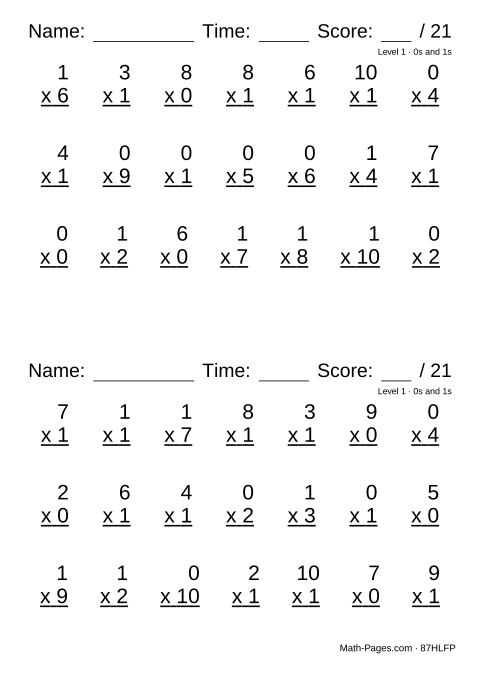
A ladder of short tests, one times table per level, in the order most teachers teach them: 0 and 1 first, then 2, 5 and 10, then 3 and 4, then 6 and 9, and 7 and 8 last, with a mixed test at the top. Each table's test is a half sheet of 21 facts - the whole table, both ways round, every fact exactly once - so a child who passes it has answered every fact in the table, not just the ones a random sheet happened to draw.
The level is printed in the header and on the answer key, so a stack of tests sorts itself back into levels. Choose the level under Level, and 12 under Tables up to for the 11s and 12s. Every test is generated fresh, so a retest at the same level is a different sheet. Levels work for addition and subtraction too: on any addition page, open Advanced options and turn on Fact levels.
What this worksheet covers
- Recall every fact of one times table, in both orders
- Pass a short test to move up to the next table
- Recall mixed multiplication facts once every table is passed
Common Core standards
- 3.OA.C.7 Fluently multiply and divide within 100; know all products of two one-digit numbers from memory.
Frequently asked questions
Why does each level test a whole times table?
Because that is how children and teachers talk about it: passing the 7s means knowing every fact with a 7 in it. A whole table also reviews the tables before it. By the time a child reaches the 8s, every 8 fact except 8 x 8 has already come up in an earlier table the other way round, so the test checks the old facts while it adds the one new one.
When is a child ready for the next level?
A common rule is all 21 right, or one wrong, inside a time you set for that child. Writing speed puts a floor under the time for younger children, so compare a child with their own last attempt rather than with the class. A child who misses the same fact on two tests is better served by a day of practice on that fact than by a third test.
Should the level tests be timed?
Not until a child can work the facts out reliably. Switch off Timed test and the time and score box gives way to name and date, which turns the same sheet into an accuracy check. Timing a child who is still counting up on their fingers measures how fast they count, and mostly teaches them that they are slow.
How many facts are in each level?
Twenty-one for each table from 2 to 10: the table runs from 0 to 10, every fact appears both ways round, and the square is only counted once. The 0s and 1s level holds 40 facts, so its 21-problem test is a sample of them, and the mixed level draws from all 121. With tables up to 12, each table holds 25 facts and the test grows to 30.