Multiplication and Division Fact Families
Free printable multiplication and division fact family worksheets. Two factors and their product, four equations to write, with an answer key.
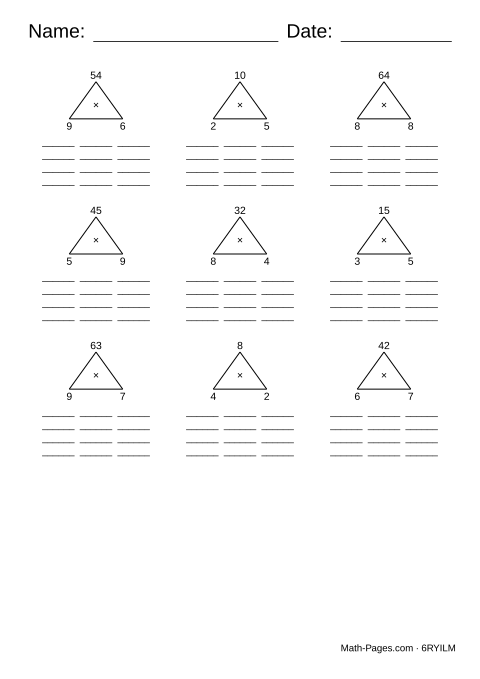
The multiplication version of a fact family: 6, 7 and 42 give 6 x 7 = 42, 7 x 6 = 42, 42 / 6 = 7 and 42 / 7 = 6. Each problem shows the two factors and the product in a triangle, and the student writes the four equations.
This is how division is taught as the inverse of multiplication in third grade. A student who knows 6 x 7 = 42 can read the two division facts straight off the family instead of learning them separately. The product always divides evenly, because every family is built from its two factors.
What this worksheet covers
- Write the two multiplication and two division facts for three numbers
- Use a multiplication fact to find the matching division facts
Common Core standards
- 3.OA.B.5 Apply properties of operations, such as the commutative property, as strategies to multiply and divide.
- 3.OA.B.6 Understand division as an unknown-factor problem.
Frequently asked questions
Why build from the factors and not the product?
So the division always comes out whole. If you picked a product first and looked for factors, you would keep landing on primes and awkward numbers.
What grade is this?
Third grade, once the times tables are becoming familiar. It is the bridge from knowing a multiplication fact to knowing the matching division fact.
Can I mix addition and multiplication families?
Yes - tick both Addition and Multiplication in the operator bar and the sheet alternates additive and multiplicative families, which is a good review once both are known.
Is there a number bond version?
Yes - the Fact Families format has a Number bond question type. For multiplication it draws the product and the two factors as connected circles.