Number Bonds Worksheets
Free printable number bonds worksheets. A whole and its two parts drawn as connected circles, one left blank, with an answer key.
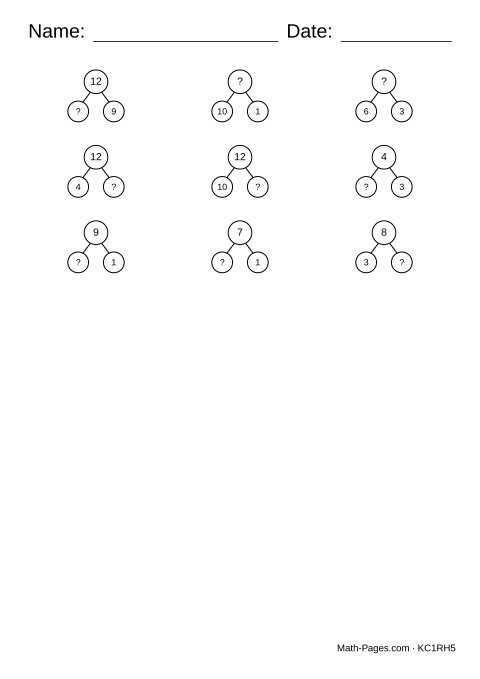
A number bond is a whole number with its two parts drawn hanging off it - three circles joined by lines. One of the three is left empty, and the student fills it in. It is the same relationship as a fact family, drawn rather than written.
If your child brought the term home from school and you are not sure what it means: it is just part-part-whole. 7 is made of 3 and 4; the bond shows that at a glance. Filling in the missing circle is practice at seeing a number as the sum of two smaller ones, which is what mental addition and subtraction are built on.
What this worksheet covers
- Find the missing part or whole in a number bond
- See a number as two parts that add up to it
Common Core standards
- 1.OA.B.4 Understand subtraction as an unknown-addend problem.
- 1.OA.D.8 Find the unknown whole number in an addition or subtraction equation.
Frequently asked questions
What is a number bond?
A diagram of a number and the two smaller numbers that make it - a whole in one circle, two parts in two others, joined by lines. It shows part-part-whole without any equation.
What age are number bonds for?
Kindergarten through second grade. Bonds to 10 come first, then to 20, then larger.
How is a number bond different from a fact family?
Same idea, different picture. A number bond is the drawn diagram; a fact family is the four written equations. Switch between them under Question.
Which circle is blank?
It varies - sometimes the whole, sometimes a part. Working out a missing part and working out the whole are slightly different, and both are worth practising.