Order of Operations with Exponents
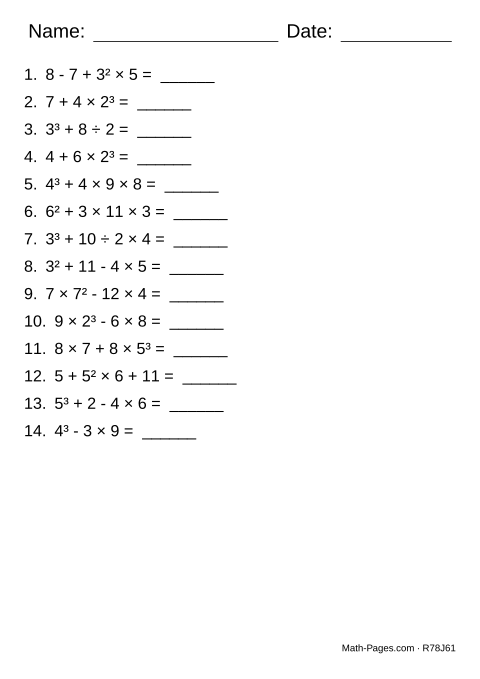
Free printable order of operations worksheets with exponents, for 6th grade PEMDAS practice. Every answer is a whole number, with an answer key.
Sixth grade is where order of operations becomes a whole-expression skill: parentheses, exponents, and knowing that multiplication and division are done left to right rather than multiplication first. Every expression here has a squared or cubed term in it, which is the piece that is new at this grade.
Every expression is built so that working left to right gives the wrong answer - a student who has the rule can tell them apart, and a student who does not cannot. There are no parentheses at this level; PEMDAS Worksheets is the page for those.
What this worksheet covers
- Evaluate expressions with whole-number exponents
- Apply the full order of operations, working multiplication and division left to right
Common Core standards
- 6.EE.A.1 Write and evaluate numerical expressions with whole-number exponents.
- 6.EE.A.2c Evaluate expressions, including at given values of their variables, using the order of operations.
Frequently asked questions
How big do the exponents get?
Squares and cubes of small numbers only. This is the E in PEMDAS, not a full exponents unit - powers of ten and negative exponents are a separate topic.
Why does every expression 'trick' you?
By design. An expression that gives the same answer left to right as it does with the rules applied tests nothing. Every problem here is one where the order matters.
Does PEMDAS mean multiplication comes before division?
No. Multiplication and division have the same rank and are done left to right, whichever comes first. The same goes for addition and subtraction. 24 ÷ 4 x 2 is 12, not 3.
How large are the answers?
Usually in the tens or hundreds: half are under about 120 and nine in ten are under 800. A cube multiplied by two other numbers can run into the thousands, so leave working space.
Are there negative answers or remainders?
No. Every answer is a positive whole number, every step on the way to it is a whole number, and every division divides evenly.